
Cell Therapy Market
Cell Therapy Market Outlook 2034: Growth, Trends, Opportunities, and Forecast Analysis
Published Date: August - 2025 | Publisher: MRA | No of Pages: 110 | Industry: Healthcare | Format: 
Cell Therapy Market Size Trends & Growth
·
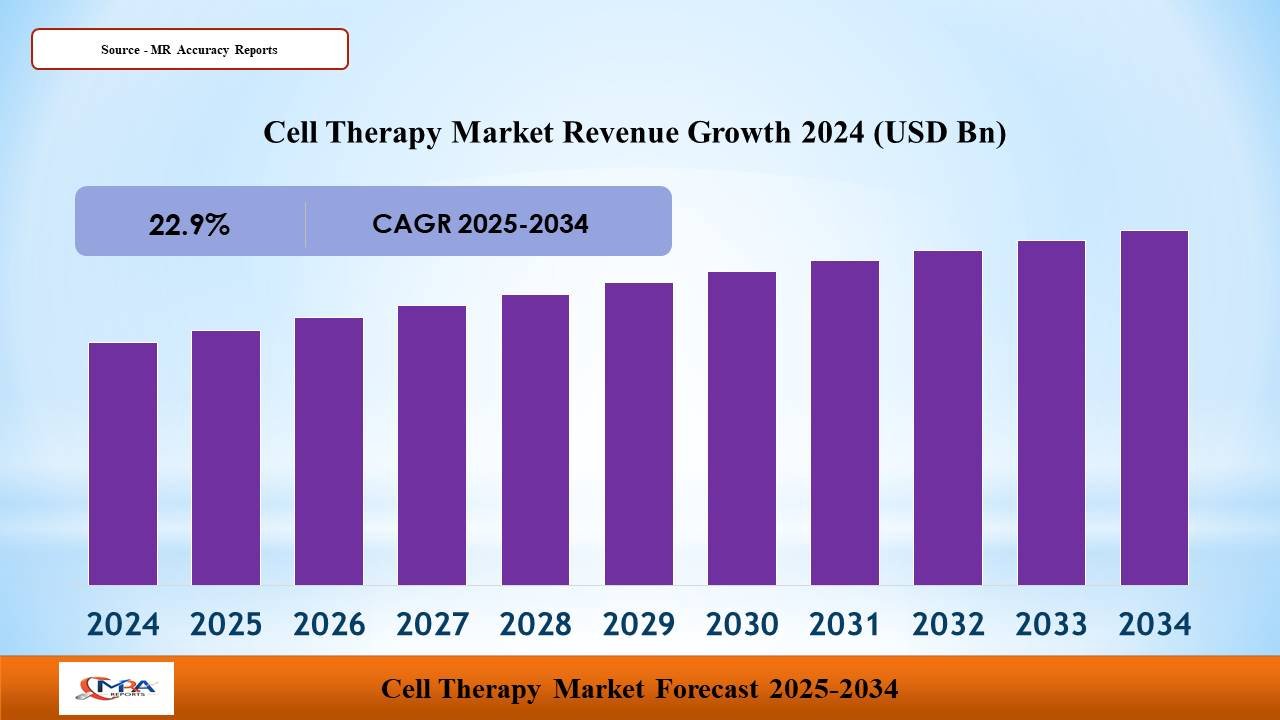
The global cell therapy market was valued at US$ 5.1 Bn in 2024.
·
The industry is expected to expand at a CAGR of 22.9% from 2025 to
2034.
·
By the end of 2034, the market size is projected to exceed US$ 51.6
Bn.
·
Strong R&D investments, rising prevalence of chronic diseases, and
advancements in regenerative medicine are driving this growth.
Market Definition & Scope
Cell therapy
is a branch of regenerative medicine involving the administration of living
cells to repair, replace, or regenerate damaged tissues and organs. Therapeutic
cell sources include adult stem cells, induced pluripotent stem cells (iPSCs),
embryonic stem cells, immune effector cells (e.g., T cells, NK cells), and
dendritic cells. Approaches may be autologous (patient-derived) or allogeneic
(donor-derived), and can incorporate genetic engineering (e.g., CAR-T,
engineered TCR-T) to enhance targeting and persistence.
Key Market Trends & Insights
- Growing adoption of
personalized medicine and precision oncology.
- Rapid expansion of clinical
trials in regenerative and cell-based immunotherapies.
- Strong R&D investments from
biopharma and governments; improving funding climate for manufacturing
scale-up and platforms.
- Advancements in gene editing,
vector design, and manufacturing (closed, automated systems, QC analytics)
that reduce cost and improve reproducibility.
- Supportive regulatory pathways
and expedited designations that compress timelines to approval.
- Rising clinician and patient
awareness of cell therapy benefits, supported by maturing real‑world
evidence.
Future Outlook & Opportunities
- Broader use of engineered cell
therapies beyond hematologic malignancies to solid tumors (overcoming TME
barriers, next‑gen CARs, armored cells).
- Expansion into autoimmune,
neurological, and cardiovascular indications via immune resetting, tissue
regeneration, and anti-inflammatory mechanisms.
- Growth in off‑the‑shelf allogeneic
platforms (e.g., iPSC‑derived) to improve access, logistics, and margins
versus bespoke autologous models.
- Industrialization
opportunitiesvector supply, closed-system manufacturing, analytics, cell
handling logistics, cryo-chain and digital tracking.
- Emerging markets and APAC
manufacturing hubs; partnerships with hospitals/academic centers for
point-of-care models.
- Health-economic evidence and
innovative reimbursement (outcomes-based, annuity models) to drive payer
adoption.
Cell Therapy Market Size, Trends & Growth Drivers
The global cell therapy market is experiencing rapid expansion, driven by strong R&D investments, rising prevalence of chronic diseases, and continuous advancements in regenerative medicine. Increasing demand for innovative therapies to treat cancer, cardiovascular disorders, and autoimmune diseases is further fueling market growth. Companies are heavily investing in clinical trials and product innovation to improve treatment efficacy and accessibility. Among regions, North America dominated the global cell therapy market in 2024, holding the largest market share. This dominance is attributed to advanced healthcare infrastructure, high adoption of novel therapies, significant research funding, and favorable regulatory support in the region.
Detailed Market Narrative
Cell Therapy Market Outlook
Cell therapy
leverages the unique properties of cells to repair or regenerate tissues across
multiple therapeutic domains. Development typically begins with selecting
appropriate cell sources—adult stem cells, iPSCs, embryonic stem cells, or
immune cells—followed by isolation and, when applicable, genetic modification
to enhance therapeutic function.
Illustrative
exampleCAR‑T
(Chimeric Antigen Receptor T‑cell) therapy is created by extracting a patient’s
T cells, engineering them to express receptors that target tumor antigens,
expanding the modified cells, and reinfusing them to eliminate cancer cells.
Applications
span orthopedics, cardiology, immunology, and oncology. CAR‑T therapies
have transformed care for certain blood cancers (e.g., ALL, NHL). Active
research is broadening cell therapy utility to solid tumors by improving
trafficking, infiltration, and persistence within immunosuppressive
microenvironments. In immunology, cell therapies aim to reprogram or replace
dysfunctional immune cells to treat autoimmune diseases (e.g., rheumatoid
arthritis, multiple sclerosis).
Drivers
1) Rising
Incidence of Oncological Disorders
- Cancer remains a leading global
cause of morbidity and mortality, with millions of new cases annually,
underscoring the need for more effective, targeted treatments.
- Traditional options
(chemotherapy, radiation) have limited efficacy and significant toxicity
in late-stage disease, prompting demand for novel approaches.
- Immune cell therapies (e.g.,
CAR‑T) harness the immune system to specifically recognize and eliminate
malignant cells and are catalyzing investment and pipeline growth.
- Advances in genetic engineering
(e.g., gene editing, signaling domain optimization) are broadening
applicability and improving durability of responses.
2)
Increasing Financing & Investments in Cell Therapy
- Significant capital inflows
from both public and private sectors are accelerating R&D, clinical
programs, and commercialization.
- ExampleIn October 2024,
Bayer AG announced a US$ 250 Mn cell therapy manufacturing
facility in Berkeley, California (U.S.) to support BlueRock
Therapeutics’ Parkinson’s program (bemdaneprocel/BRT‑DA01), illustrating
strategic, long-horizon investment in scalable production.
- Funding enables capacity
expansion, faster trials, and infrastructure build‑out for broader
adoption.
Cell Therapy Market Snapshot
Report Coverage | Detail |
Size in 2024 | US$ 5.1 Bn |
Forecast Value in 2034 | More than US$ 51.6 Bn |
CAGR (2025–2034) | 22.9% |
Forecast Period | 2025–2034 |
Historical Data Available for | 2020–2024 |
Quantitative Units | US$ Bn (Value) |
Market Analysis | Segment analysis and regional analysis; qualitative review of drivers, restraints, opportunities, key trends, value chain, and key trend analysis. |
Competition Landscape | Competition matrix; company profiles with overview, product portfolio, sales footprint, key subsidiaries/distributors, strategy & recent developments, key financials. |
Format | Electronic (PDF) + Excel |
Segmentation | Cell Therapy Type; Origin; Therapeutic Area; Regions |
Companies Profiled | Novartis AG; Bristol‑Myers Squibb; IOVANCE Biotherapeutics; Janssen Biotech; CellTrans; Gamida Cell; Dendreon Pharmaceuticals; Kite Pharma; Adaptimmune; Takeda Pharmaceutical Company Limited |
Customization Scope | Available upon request |
Pricing | Available upon request |
High Demand for T‑Cell Therapies
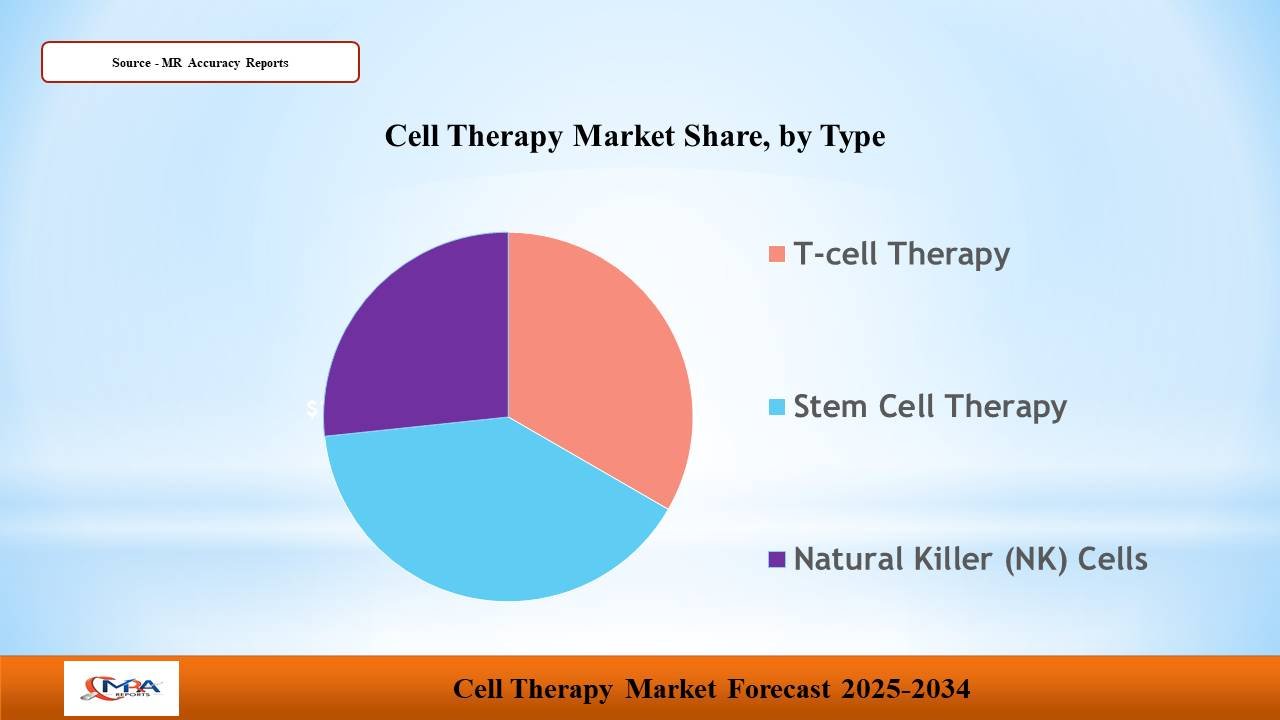
- Market segmentation by therapy
type includes T‑cell therapy, stem cell therapy, natural killer (NK)
cells, dendritic cells, and other cell therapies.
- With approvals of CAR‑T
products (e.g., Tecartus, Yescarta, Kymriah), many companies have
pivoted from small molecules/biologics to adoptive cell therapies,
boosting strategic investment.
- Rising approvals and
manufacturing capacity are intensifying competition in T‑cell therapy;
process enhancements are improving yields, turnaround times, and cost
structures.
- Next‑generation strategies (second/next‑gen CARs, logic‑gated
CARs, safety switches, gene‑edited allogeneic donors) aim to overcome
resistance, reduce adverse events, and expand indications.
Therapeutic AreasOncological Disorders Driving
Market Statistics
- By therapeutic area, the market
includes Oncological Disorders, Autoimmune Disorders, Neurological
Disorders, and Others.
- Oncology dominates, propelled by
patient-assistance programs (PAPs), government awareness initiatives,
rising cancer incidence, robust R&D by key players, and demand for
personalized medicine.
- Example initiativeIn November
2024, the American Cancer Society launched ACS CARES, a
mobile‑app program for one‑on‑one support and information access,
improving care navigation and potentially supporting therapy adoption.
Regional Outlook of the Cell Therapy Industry
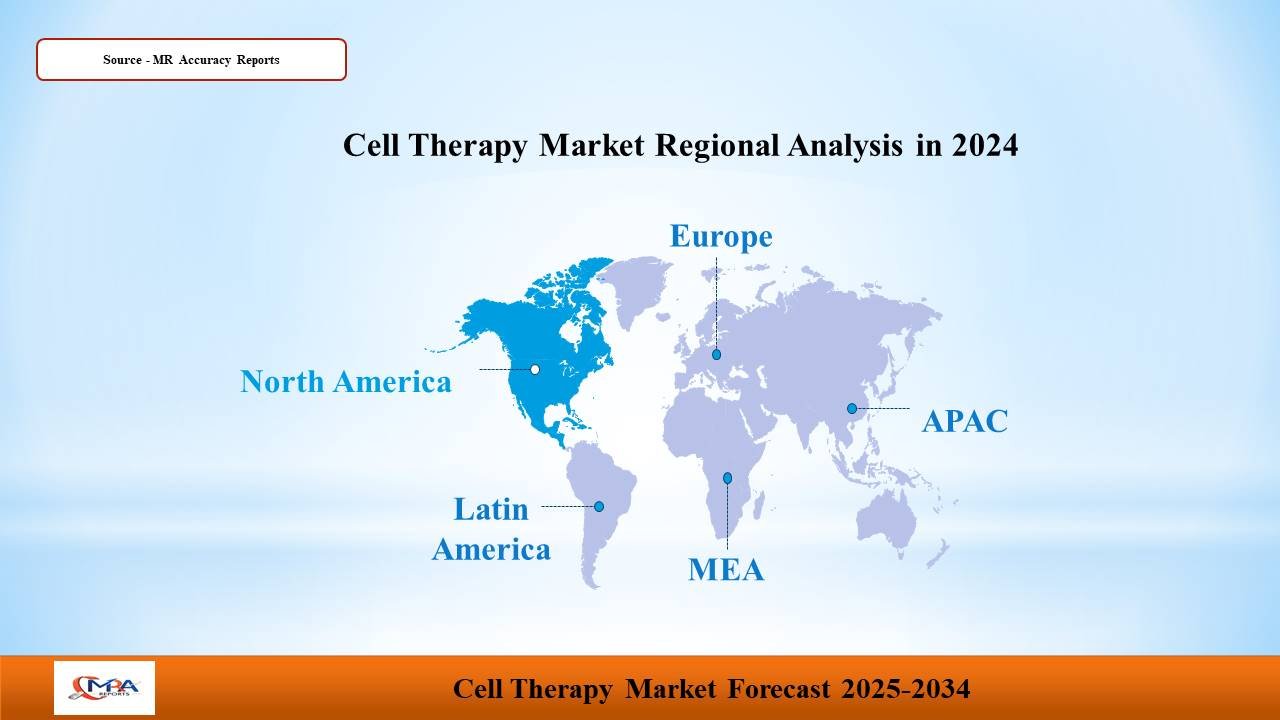
- Leading regionNorth America (dominated in 2023 and
held the largest share in 2024), supported by advanced healthcare
infrastructure, strong R&D ecosystems, and higher healthcare spending.
- The U.S. leads North
America due to technology leadership, broad clinical trial networks, and
concentration of cell therapy developers and manufacturers.
- EuropeIncreased funding and
coordinated initiatives (e.g., EU research programs, the UK’s Cell
& Gene Therapy Catapult, Germany’s national initiatives) provide
infrastructure, translational support, and regulatory guidance.
- APACRapid build‑out of
biomanufacturing capacity and clinical sites supports future growth;
partnerships and localization strategies will be key for access and cost
control.
Analysis of Key Players
Prominent
companies include Novartis AG; Bristol‑Myers Squibb Company; IOVANCE
Biotherapeutics, Inc.; Janssen Biotech, Inc.; CellTrans, Inc.; Gamida Cell
Inc.; Dendreon Pharmaceuticals LLC; Kite Pharma, Inc.; Adaptimmune; and Takeda
Pharmaceutical Company Limited.
These players are profiled on company overview, financials, strategy, product
portfolio, segments, and recent developments.
Segmentation
By Cell
Therapy Type
- T‑cell Therapy
- Chimeric Antigen Receptor
(CAR) T‑cells
- T‑cell Receptors (TCR‑T)
- Tumor‑Infiltrating Lymphocytes
(TILs)
- Stem Cell Therapy
- Natural Killer (NK) Cells
- Dendritic Cells
- Other Cell Therapies
By Origin
- Autologous Therapies
- Allogeneic Therapies
By
Therapeutic Area
- Oncological Disorders
- Autoimmune Disorders
- Neurological Disorders
- Others
By Region
- North America
- Europe
- Asia Pacific
- Latin America
- Middle East & Africa
Frequently Asked Questions
The global cell therapy market was estimated at US$ 5.1 billion in 2024.
The market is forecast to expand and surpass US$ 51.6 billion by 2034.
The industry is expected to grow at a CAGR of 22.9% between 2025 and 2034.
Novartis AG, Bristol-Myers Squibb
Company, IOVANCE Biotherapeutics, Inc., Janssen Biotech, Inc., CellTrans, Inc.,
Gamida Cell Inc., Dendreon Pharmaceuticals LLC, Kite Pharma, Inc., Adaptimmune,
and Takeda Pharmaceutical Company Limited
Related Reports
Table of Content
1. Summary
1.1. Market Definition and Scope
1.2. Market Segmentation
1.3. Key Research Objectives
1.4. Research Highlights
2. Assumptions and Research Methodology
3. Executive Summary: Global Cell Therapy Market
4. Market Overview
4.1. Introduction
4.1.1. Segment Definition
4.1.2. Industry Evolution / Developments
4.2. Overview
4.3. Market Dynamics
4.3.1. Drivers
4.3.2. Restraints
4.3.3. Opportunities
4.4. Global Cell Therapy Market Analysis and Forecasts, 2020 & 2034
4.4.1. Market Revenue Projections (US$ Bn)
5. Key Insights
5.1. Regulatory Landscape across Key Regions / Countries
5.2. Market Trends
5.3. PORTER’s Five Forces Analysis
5.4. PESTEL Analysis
5.5. Key Purchase Metrics for End-users
5.6. Brand and Pricing Analysis
5.7. Go to Marketing Strategies
5.8. End-users Preference
6. Global Cell Therapy Market Analysis and Forecasts, By Device Type
6.1. Introduction & Definition
6.2. Key Findings / Developments
6.3. Market Value Forecast By Device Type, 2020 & 2034
7. Competition
Landscape
15.1. Market Player – Competition Matrix (By Tier and Size of companies)
15.2. Market Share Analysis By Company (2024)
15.3. Company Profiles
15.3.1. Company-1
15.3.1.1. Company Overview
15.3.1.2. Financial Overview
15.3.1.3. Product Portfolio
15.3.1.4. Business Strategies
15.3.1.5. Recent Developments
List of Figures
Figure 1: Global Cell Therapy Market Revenue Breakdown
(USD billion, %) by Region, 2025 & 2034
Figure 2: Global Cell Therapy Market Value Share (%),
by Type, 2025 & 2034
Figure 3: Global Cell Therapy Market Value Share (%),
by Application, 2025 & 2034
Figure 4: Global Cell Therapy Market Value Share
(%), by End-user, 2025 & 2034
Figure 5: North America Cell Therapy Market Value (USD
billion), by Type, 2025 & 2034
Figure 6: North America Cell Therapy Market Value
Share (%), by Type, 2024
Figure 7: North America Cell Therapy Market Value (USD
billion), by Application, 2025 & 2034
Figure 8: North America Cell Therapy Market Value
Share (%), by Application, 2024
Figure 9: North America Cell Therapy Market Value (USD
billion), By Country, 2025 & 2034
Figure 10: North America Cell Therapy Market Value
(USD billion), by End-user, 2025 & 2034
Figure 11: North America Cell Therapy Market
Value Share (%), by End-user, 2024
Figure 12: Europe Cell Therapy Market Value Share (%),
by Type, 2024
Figure 13: Europe Cell Therapy Market Value (USD
billion), by Application, 2025 & 2034
Figure 14: Europe Cell Therapy Market Value Share (%),
by Application, 2024
Figure 15: Europe Cell Therapy Market Value (USD
billion), By Country/ Sub-region, 2025 & 2034
Figure 16: Europe Cell Therapy Market Value Share (%),
By Country/ Sub-region, 2024
Figure 17: Asia Pacific Cell Therapy Market Value (USD
billion), by Type, 2025 & 2034
Figure 18: Europe Cell Therapy Market Value (USD
billion), by End-user, 2025 & 2034
Figure 19: Europe Cell Therapy Market Value
Share (%), by End-user, 2024
Figure 20: Asia Pacific Cell Therapy Market Value
Share (%), by Application, 2024
Figure 21: Asia Pacific Cell Therapy Market Value (USD
billion), By Country/ Sub-region, 2025 & 2034
Figure 22: Asia Pacific Cell Therapy Market Value
Share (%), By Country/ Sub-region, 2024
Figure 23: Rest of the World Cell Therapy Market Value
(USD billion), by Type, 2025 & 2034
Figure 24: Rest of the World Cell Therapy Market Value
Share (%), by Type, 2024
Figure 25: Rest of the World Cell Therapy Market Value
(USD billion), by Application, 2025 & 2034
Figure 26: Asia Pacific Cell Therapy Market
Value (USD billion),by End-user, 2025 & 2034
Figure 27: Asia Pacific Cell Therapy Market
Value Share (%), by End-user, 2024
Figure 28: Asia Pacific Cell Therapy Market
Value (USD billion), By Country/ Sub-region, 2025 & 2034
Figure 29: Asia Pacific Cell Therapy Market
Value Share (%), By Country/ Sub-region, 2024
Figure 30: Rest of World Cell Therapy Market
Value (USD billion), by Type, 2025 & 2034
Figure 31: Rest of World Cell Therapy Market
Value Share (%), by Type, 2024
Figure 32: Rest of World Cell Therapy Market
Value (USD billion), by Application, 2025 & 2034
Figure 33: Rest of World Cell Therapy Market
Value Share (%), by Application, 2024
Figure 34: Rest of World Cell Therapy Market
Value (USD billion), by End-user, 2025 & 2034
Figure 35: Rest of World Cell Therapy Market
Value Share (%), by End-user, 2024
Figure 36: Global Cell Therapy Market Share (%),
By Company, 2024
Table 1:
Global Cell Therapy Market Revenue (USD billion) Forecast, by Type, 2020–2034
Table 2:
Global Cell Therapy Market Revenue (USD billion) Forecast, by Product, 2020–2034
Table 3:
Global Cell Therapy Market Revenue (USD billion) Forecast, by Software, 2020–2034
Table 4:
Global Cell Therapy Market Revenue (USD billion) Forecast, by Services, 2020–2034
Table 5:
Global Cell Therapy Market Revenue (USD billion) Forecast, by Application, 2020–2034
Table 6:
Global Cell Therapy Market Revenue (USD billion) Forecast, by Menstruation Care
& Fertility Tracking, 2020–2034
Table 7:
Global Cell Therapy Market Revenue (USD billion) Forecast, by End-user 2020–2034
Table 8:
Global Cell Therapy Market Revenue (USD billion) Forecast, by Region, 2020–2034
Table 9:
North America Cell Therapy Market Revenue (USD billion) Forecast, by Type, 2020–2034
Table 10:
North America Cell Therapy Market Revenue (USD billion) Forecast, by Product, 2020–2034
Table 11:
North America Cell Therapy Market Revenue (USD billion) Forecast, by Software, 2020–2034
Table 12:
North America Cell Therapy Market Revenue (USD billion) Forecast, by Services, 2020–2034
Table 13:
North America Cell Therapy Market Revenue (USD billion) Forecast, by
Application, 2020–2034
Table 14:
North America Cell Therapy Market Revenue (USD billion) Forecast, by
Menstruation Care & Fertility Tracking, 2020–2034
Table 15:
North America Cell Therapy Market Revenue (USD billion) Forecast, by End-user 2020–2034
Table 16:
North America Cell Therapy Market Revenue (USD billion) Forecast, By Country, 2020–2034
Table 17:
Europe Cell Therapy Market Revenue (USD billion) Forecast, by Type, 2020–2034
Table 18:
Europe Cell Therapy Market Revenue (USD billion) Forecast, by Product, 2020–2034
Table 19:
Europe Cell Therapy Market Revenue (USD billion) Forecast, by Software, 2020–2034
Table 20:
Europe Cell Therapy Market Revenue (USD billion) Forecast, by Services, 2020–2034
Table 21:
Europe Cell Therapy Market Revenue (USD billion) Forecast, by Application, 2020–2034
Table 22:
Europe Cell Therapy Market Revenue (USD billion) Forecast, by Menstruation Care
& Fertility Tracking, 2020–2034
Table 23:
Europe Cell Therapy Market Revenue (USD billion) Forecast, by End-user 2020–2034
Table 24:
Europe Cell Therapy Market Revenue (USD billion) Forecast, By Country/
Sub-region, 2020–2034
Table 25:
Asia Pacific Cell Therapy Market Revenue (USD billion) Forecast, by Type, 2020–2034
Table 26:
Asia Pacific Cell Therapy Market Revenue (USD billion) Forecast, by Product, 2020–2034
Table 27:
Asia Pacific Cell Therapy Market Revenue (USD billion) Forecast, by Software, 2020–2034
Table 28:
Asia Pacific Cell Therapy Market Revenue (USD billion) Forecast, by Services, 2020–2034
Table 29:
Asia Pacific Cell Therapy Market Revenue (USD billion) Forecast, by Application,
2020–2034
Table 30:
Asia Pacific Cell Therapy Market Revenue (USD billion) Forecast, by
Menstruation Care & Fertility Tracking, 2020–2034
Table 31:
Asia Pacific Cell Therapy Market Revenue (USD billion) Forecast, by End-user 2020–2034
Table 32:
Asia Pacific Cell Therapy Market Revenue (USD billion) Forecast, By Country/
Sub-region, 2020–2034
Table 33:
Rest of World Cell Therapy Market Revenue (USD billion) Forecast, by Type, 2020–2034
Table 34:
Rest of World Cell Therapy Market Revenue (USD billion) Forecast, by Product, 2020–2034
Table 35:
Rest of World Cell Therapy Market Revenue (USD billion) Forecast, by Software, 2020–2034
Table 36:
Rest of World Cell Therapy Market Revenue (USD billion) Forecast, by Services, 2020–2034
Table 37:
Rest of World Cell Therapy Market Revenue (USD billion) Forecast, by
Application, 2020–2034
Table 38:
Rest of World Cell Therapy Market Revenue (USD billion) Forecast, by
Menstruation Care & Fertility Tracking, 2020–2034
Table 39:
Rest of World Cell Therapy Market Revenue (USD billion) Forecast, by End-user 2020–2034
- Bluebird Bio
- Adaptimmune
- Gilead Sciences
- Celyad
- Kite Pharma
- Sangamo Therapeutics
- Allogene Therapeutics
- TCR2 Therapeutics
- Celgene
- Novartis
- Fate Therapeutics
- BristolMyers Squibb
- AstraZeneca
- Amgen
- Juno Therapeutics
Claim a Free Sample
Get a preview with key statistics, projections, and trends for this report. Ideal for quick insights.
Send Me a SampleNeed full access?
Purchase Report